No questions here on Borders, Civilizations, History, Historical flags, Turning points, Religion — nothing recorded for Cape Verde.
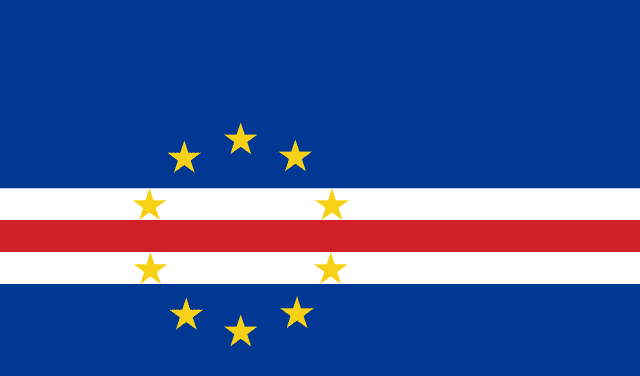
Cape Verde
Cape Verde, also referred to in English by its Portuguese name Cabo Verde, and known officially as the Republic of Cabo Verde, is an archipelagic country in the eastern Atlantic Ocean, off the coast of West Africa. It consists of ten volcanic islands with a combined land area of about 4,033 square kilometres (1,557 sq mi). These islands lie between 600 and 850 kilometres west of Cap-Vert, the westernmost point of continental Africa, after which they are named. Cape Verde forms part of the Macaronesia ecoregion, along with the Azores, the Canary Islands, Madeira and the Savage Islands.
Read Cape Verde on Wikipedia · Recent news from Cape Verde
You have not been asked about Cape Verde yet.
WHAT PEOPLE ARE CALLED
Cape Verdean
These are English demonyms for people from Cape Verde. A demonym describes a connection to a place; it does not mean everyone shares an ethnicity, language or religion.
Demonym source: mledoze/countries · Download the attributed dataset (ODbL)SAME LAND, DIFFERENT WORLDS
Civilizations, flags & standards
Modern borders are a starting point for exploring the past. These cultures and states occupied some of the same land; they were not the same country. Dates describe each civilization or state as a whole, not continuous rule over every place listed.
A sourced civilization and flag trail has not been added for Cape Verde yet. No ancient flag is inferred from the modern one.
Explore the history of this land · Browse civilizations & empires
Turning points
A curated timeline is not available yet. Explore the country's history and the historical figures below.
Read the historical overview →Religion: state & society
An official religion is a legal status. The largest religious group is a population measure. Neither describes every person's beliefs.
Official status and a dated affiliation breakdown have not been checked for this country. The atlas's religion tags are not a population ranking.
BEYOND THE MAP
Cape Verde in the study desk
Places and things the general-knowledge library connects to Cape Verde. Open one to follow its connections, then practise them with typed recall.
Food & drink 1
Choose your next rabbit hole
Languages
Share of the population that speaks each. Click one to see every country that speaks it.
What it sells, and to whom
Every line is a thread: click a commodity or a partner to see who else trades in it.
Trades with
Farms and fisheries
- sugarcane
- tomatoes
- coconuts
- pulses
- goat milk
- milk
Money, belief and alliances
Money
Belongs to
Climate and geography
temperate; warm, dry summer; precipitation meager and erratic
Climate zone
Highest point
Landmarks and landscapes
Northern hemisphere.
In charge right now


Figures from its history


Leaders before them


Corrected in an AI-assisted review of the imported data (2026-09-22), not yet checked against a named source: climate zone, landmarks, past leaders.