No questions here on Civilizations, Historical flags, Turning points, Religion — nothing recorded for Uruguay.
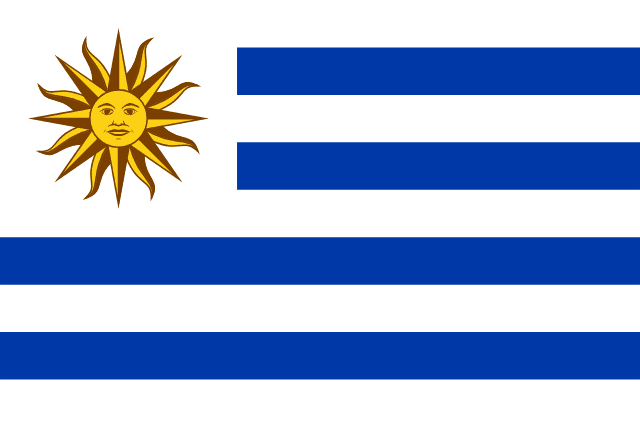
Uruguay
Uruguay, officially the Oriental Republic of Uruguay, is a country in southeastern South America. It shares borders with Argentina to its west and southwest and Brazil to its north and northeast, while bordering the Río de la Plata to the south and the Atlantic Ocean to the southeast. It is part of the Southern Cone region of South America. Uruguay covers an area of approximately 176,215 square kilometers (68,037 sq mi). It has a population of almost 3.5 million people, of whom nearly 2 million live in the metropolitan area of its capital and largest city, Montevideo.
Read Uruguay on Wikipedia · Recent news from Uruguay
You have not been asked about Uruguay yet.
WHAT PEOPLE ARE CALLED
Uruguayan
These are English demonyms for people from Uruguay. A demonym describes a connection to a place; it does not mean everyone shares an ethnicity, language or religion.
Demonym source: mledoze/countries · Download the attributed dataset (ODbL)SAME LAND, DIFFERENT WORLDS
Civilizations, flags & standards
Modern borders are a starting point for exploring the past. These cultures and states occupied some of the same land; they were not the same country. Dates describe each civilization or state as a whole, not continuous rule over every place listed.
A sourced civilization and flag trail has not been added for Uruguay yet. No ancient flag is inferred from the modern one.
Explore the history of this land · Browse civilizations & empires
Turning points
A curated timeline is not available yet. Explore the country's history and the historical figures below.
Read the historical overview →Religion: state & society
An official religion is a legal status. The largest religious group is a population measure. Neither describes every person's beliefs.
Official status and a dated affiliation breakdown have not been checked for this country. The atlas's religion tags are not a population ranking.
Choose your next rabbit hole
Where it is
Languages
Share of the population that speaks each. Click one to see every country that speaks it.
What it sells, and to whom
Every line is a thread: click a commodity or a partner to see who else trades in it.
Trades with
Natural resources
Industries
Farms and fisheries
- milk
- rice
- wheat
- barley
- soybeans
- beef
Largest cities
| Montevideo capital | 1,270,737 |
| Salto | 114,084 |
| Maldonado | 102,000 |
| Rivera | 84,775 |
| Paysandú | 81,550 |
Wars and conflicts
Conflicts this country is attached to. Click one to see the others. Each says what kind of claim it is: a principal belligerent is hand-checked against the modern state that succeeded the power that fought, while a recorded participant comes from the bulk import, which does not separate combat from funding, basing, occupation or reconstruction. Neither list is complete, so a country missing from a war may still have taken part — which is why the quiz no longer asks who fought in what.
Money, belief and alliances
Money
Belongs to
Climate and geography
warm temperate; freezing temperatures almost unknown
Climate zone
Highest point
Landmarks and landscapes
Southern hemisphere.
In charge right now

Figures from its history


Corrected in an AI-assisted review of the imported data (2026-09-22), not yet checked against a named source: official languages.