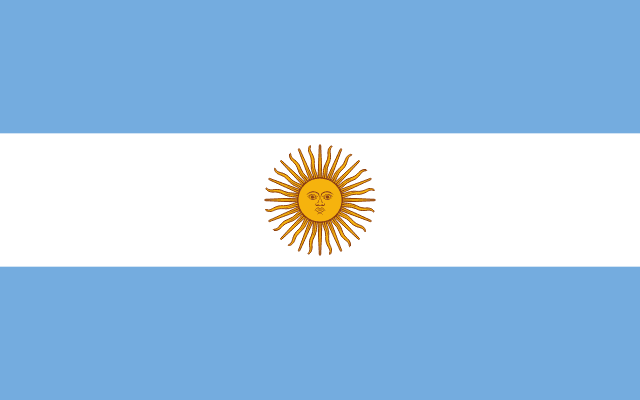
No questions here on Historical flags, Turning points, Religion — nothing recorded for Argentina.
Argentina
AR / ARG -34.0°, -64.0°
Argentina, officially the Argentine Republic, is a country in the far south of South America. It covers an area of 2,780,085 km2 (1,073,397 mi2), making it the second-largest country in South America after Brazil, the fourth-largest country in the Americas, and the eighth-largest country in the world. Argentina shares the bulk of the Southern Cone with Chile to the west, and is also bordered by Bolivia and Paraguay to the north, Brazil to the northeast, Uruguay and the South Atlantic Ocean to the east, and the Drake Passage to the south. Argentina is a federal state divided into twenty-three provinces, and one autonomous city, which is the federal capital and largest city of the nation, Buenos Aires. The provinces and the capital have their own constitutions, but exist under a federal system. Argentina claims sovereignty over the Falkland Islands, South Georgia and the South Sandwich Islands, the Southern Patagonian Ice Field, and a part of Antarctica.
These are English demonyms for people from Argentina. A demonym describes a connection to a place; it does not mean everyone shares an ethnicity, language or religion.
Modern borders are a starting point for exploring the past. These cultures and states occupied some of the same land; they were not the same country. Dates describe each civilization or state as a whole, not continuous rule over every place listed.
Modern attribution disputed
Inca Empire
c. 1438–1533 CE; successor resistance continued to 1572
An Andean empire centered at Cusco, covering portions of these modern countries, not their full territory.
The rainbow flag often labeled an Inca flag is modern. The flag of Cusco does not establish an ancient national-flag design.
Conflicts this country is attached to. Click one to see the others.
Each says what kind of claim it is: a principal belligerent is
hand-checked against the modern state that succeeded the power that
fought, while a recorded participant comes from the bulk
import, which does not separate combat from funding, basing,
occupation or reconstruction. Neither list is complete, so a country
missing from a war may still have taken part — which is why the
quiz no longer asks who fought in what.
Juan PeronPresident and founder of Peronism
Juan Domingo Perón was an Argentine military officer and politician who was the 29th and 40th president of Argentina, serving from 1946 to his overthrow in 1955, and from 1973 until his death in 1974.
Eva PeronFirst lady and political figure
María Eva Duarte de Perón, better known as Eva "Evita" Perón, was an Argentine politician, activist, and actress who served as First Lady of Argentina from June 1946 until her death in July 1952, as the wife of Argentine President Juan Perón.
Jose de San MartinLiberator of Argentina, Chile and Peru
José Francisco de San Martín y Matorras, nicknamed "the Liberator of Argentina, Chile and Peru", was an Argentine general and the primary leader of the southern and central parts of South America's successful struggle for independence from the Spanish Empire...
Diego MaradonaFootballer
Diego Armando Maradona was an Argentine professional football player and manager.
Corrected in an AI-assisted review of the imported data
(2026-09-22), not yet checked against a named source:
currencies, famous.