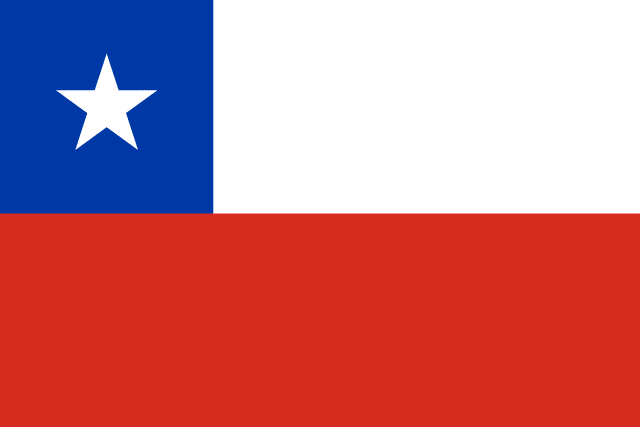
No questions here on Historical flags, Turning points, Religion — nothing recorded for Chile.
Chile
CL / CHL -33.0°, -71.0°
Chile, officially the Republic of Chile, is a country in the Southern Cone of southwestern South America. It is the southernmost country in the world and the closest to Antarctica, extending along a narrow strip of land between the Andes Mountains and the Pacific Ocean. According to the 2024 census, Chile had an enumerated population of 18.5 million. The country covers a territorial area of 756,102 square kilometers (291,933 sq mi), sharing borders with Peru to the north, Bolivia to the northeast, Argentina to the east, and the Drake Passage to the south. It also administers several Pacific islands, including Juan Fernández, Isla Salas y Gómez, Desventuradas, and Easter Island, and claims about 1,250,000 square kilometers (480,000 sq mi) of Antarctica as the Chilean Antarctic Territory. The capital and largest city is Santiago, and the official and national language is Spanish.
These are English demonyms for people from Chile. A demonym describes a connection to a place; it does not mean everyone shares an ethnicity, language or religion.
Modern borders are a starting point for exploring the past. These cultures and states occupied some of the same land; they were not the same country. Dates describe each civilization or state as a whole, not continuous rule over every place listed.
Modern attribution disputed
Inca Empire
c. 1438–1533 CE; successor resistance continued to 1572
An Andean empire centered at Cusco, covering portions of these modern countries, not their full territory.
The rainbow flag often labeled an Inca flag is modern. The flag of Cusco does not establish an ancient national-flag design.
Conflicts this country is attached to. Click one to see the others.
Each says what kind of claim it is: a principal belligerent is
hand-checked against the modern state that succeeded the power that
fought, while a recorded participant comes from the bulk
import, which does not separate combat from funding, basing,
occupation or reconstruction. Neither list is complete, so a country
missing from a war may still have taken part — which is why the
quiz no longer asks who fought in what.
Bernardo O'HigginsIndependence leader
Bernardo O'Higgins Riquelme was a Chilean military officer, statesman and a major leader of Chile's successful struggle for independence from the Spanish Empire.
Salvador AllendePresident overthrown in 1973
Salvador Guillermo Allende Gossens was a Chilean socialist politician who served as the 29th president of Chile from 1970 until his suicide in 1973.
Augusto PinochetDictator, 1973-1990
Augusto José Ramón Pinochet Ugarte was a Chilean army officer and military dictator who ruled Chile from 1973 to 1990.
Pablo NerudaNobel laureate poet
Pablo Neruda was a Chilean poet-diplomat and politician who won the 1971 Nobel Prize in Literature.
Most of this page is imported in bulk and carries no source of its
own. These entries were checked by hand against the source named,
and are reapplied after every dataset rebuild so a refetch cannot
quietly put the old value back.
Continents
— Seven-continent model. A country spanning two continents is filed under the one containing its capital; the other is accepted too.
The imported list was unordered and included overseas territory, so its first entry was not the continent the country is in. Source· true as of 2026-09-11 · checked 2026-09-11
Corrected in an AI-assisted review of the imported data
(2026-09-22), not yet checked against a named source:
currencies, past leaders.