No questions here on Historical flags, Turning points, Numbers, Religion — nothing recorded for Bolivia.
Bolivia
BO / BOL -17.1°, -65.0°
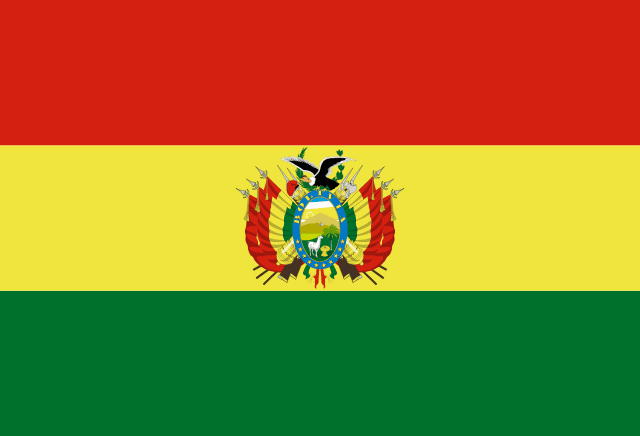
Bolivia, officially the Plurinational State of Bolivia, is a landlocked country located in central South America. Its geography primarily consists of an Andean region to the west and tropical lowlands to the east and north. The country has a diverse environment, including the vast Amazonian plain, the Gran Chaco, temperate valleys, the high-altitude Altiplano plateau, snow-capped peaks, and mountains, encompassing a wide range of climates and biomes across its regions and cities. It includes part of the Pantanal, the largest tropical wetland in the world, along its eastern border. Bolivia is bordered by Brazil to the north and east, Paraguay to the southeast, Argentina to the south, Chile to the southwest, and Peru to the west. The seat of government is La Paz, which contains the executive, legislative, and electoral branches of government, while the constitutional capital is Sucre, the seat of the judiciary. While most population and urban centers lie in the Andean region, the largest city and principal industrial center is Santa Cruz de la Sierra, located in the eastern tropical lowlands.
These are English demonyms for people from Bolivia. A demonym describes a connection to a place; it does not mean everyone shares an ethnicity, language or religion.
Modern borders are a starting point for exploring the past. These cultures and states occupied some of the same land; they were not the same country. Dates describe each civilization or state as a whole, not continuous rule over every place listed.
Modern attribution disputed
Inca Empire
c. 1438–1533 CE; successor resistance continued to 1572
An Andean empire centered at Cusco, covering portions of these modern countries, not their full territory.
The rainbow flag often labeled an Inca flag is modern. The flag of Cusco does not establish an ancient national-flag design.
Conflicts this country is attached to. Click one to see the others.
Each says what kind of claim it is: a principal belligerent is
hand-checked against the modern state that succeeded the power that
fought, while a recorded participant comes from the bulk
import, which does not separate combat from funding, basing,
occupation or reconstruction. Neither list is complete, so a country
missing from a war may still have taken part — which is why the
quiz no longer asks who fought in what.
Simon BolivarLiberator the country is named for
Simón José Antonio de la Santísima Trinidad Bolívar Palacios Ponte y Blanco was a Venezuelan military officer and statesman who led what are currently the countries of Bolivia, Colombia, Ecuador, Panama, Peru, and Venezuela to independence from the Spanish...
Evo MoralesFirst indigenous president
Juan Evo Morales Ayma is a Bolivian politician, trade union organizer, and former cocalero activist who served as the 65th President of Bolivia from 2006 to 2019.
Tupac KatariLeader of the 1781 indigenous rebellion
Túpac Katari or Catari, born Julián Apasa Nina, was an indigenous Aymara leader who started a major rebellion in colonial-era Upper Peru, laying siege to La Paz for six months.