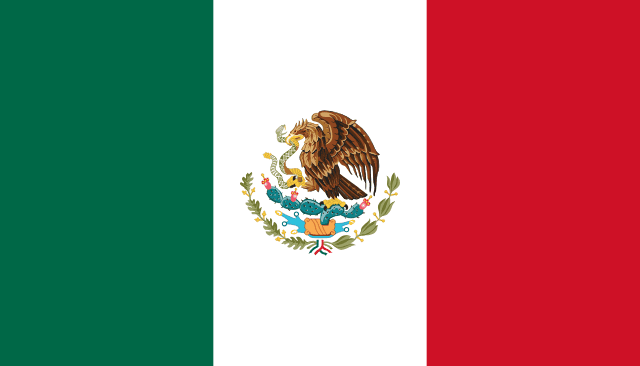
No questions here on Historical flags, Turning points, Leaders, Religion — nothing recorded for Mexico.
Mexico
MX / MEX 23.0°, -102.0°
Mexico, officially the United Mexican States, is a country in North America. It is the northernmost country in Latin America, bordering the United States of America to the north and Guatemala and Belize to the southeast, while having maritime boundaries with the Pacific Ocean to the west, the Caribbean Sea to the southeast, and the Gulf of Mexico to the east. Mexico covers 1,972,550 km2, and is the thirteenth-largest country in the world by land area. With a population exceeding 134 million as of 2026, Mexico is the tenth-most populous country in the world and is home to the largest number of native Spanish speakers. Mexico City is the capital and largest city in Mexico, which ranks among the most populous metropolitan areas in the world.
These are English demonyms for people from Mexico. A demonym describes a connection to a place; it does not mean everyone shares an ethnicity, language or religion.
Modern borders are a starting point for exploring the past. These cultures and states occupied some of the same land; they were not the same country. Dates describe each civilization or state as a whole, not continuous rule over every place listed.
No single national flag
Maya civilization
Preclassic c. 2000 BCE–250 CE; Classic c. 250–900 CE; later kingdoms continued
Southern Mexico, Guatemala, Belize and parts of Honduras and El Salvador; many separate polities, not one Maya empire. Maya peoples and cultures continue today.
Royal emblems and glyphs identified particular rulers and cities. No single flag represented this entire civilization.
Conflicts this country is attached to. Click one to see the others.
Each says what kind of claim it is: a principal belligerent is
hand-checked against the modern state that succeeded the power that
fought, while a recorded participant comes from the bulk
import, which does not separate combat from funding, basing,
occupation or reconstruction. Neither list is complete, so a country
missing from a war may still have taken part — which is why the
quiz no longer asks who fought in what.
Benito JuarezReformist president
Benito Pablo Juárez García was a Mexican politician, military officer, and lawyer who served as the 26th president of Mexico from 1858 until his death in 1872.
Emiliano ZapataRevolutionary leader
Emiliano Zapata Salazar was a Mexican revolutionary and guerrilla leader.
Frida KahloPainter
Magdalena Carmen Frida Kahlo y Calderón was a Mexican painter known for her many portraits, self-portraits, and works inspired by the nature and artifacts of Mexico.
Lazaro CardenasPresident who nationalised the oil
Lázaro Cárdenas del Río was a Mexican revolutionary, army officer, and politician who served as the 51st president of Mexico from 1934 to 1940.
Most of this page is imported in bulk and carries no source of its
own. These entries were checked by hand against the source named,
and are reapplied after every dataset rebuild so a refetch cannot
quietly put the old value back.
Leaders
— President of Mexico: head of state and head of government are the same office.
The import returned an empty leaders list for Mexico. Source· true as of 2024-10-01 · checked 2026-09-11
Corrected in an AI-assisted review of the imported data
(2026-09-22), not yet checked against a named source:
cities, currencies, famous, languages, wars.