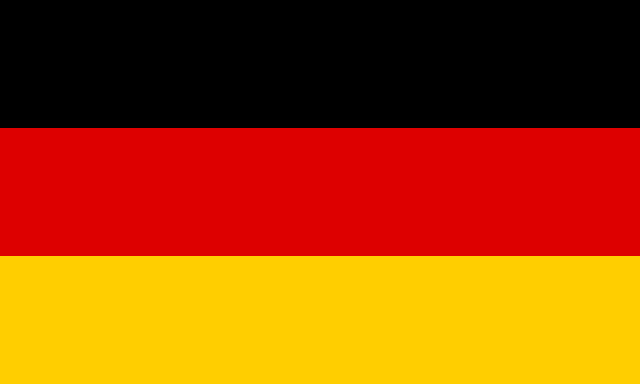
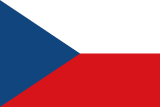
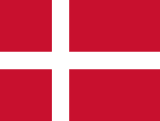
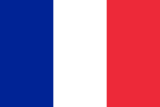
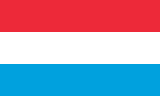
Germany, officially the Federal Republic of Germany, is a country in Western and Central Europe. It lies between the Baltic Sea and the North Sea to the north with the Alps to the south. Its 16 constituent states have a total population of over 83 million, making it the most populous member state of the European Union (EU). Germany borders Denmark to the north; Poland and the Czech Republic to the east; Austria and Switzerland to the south; and France, Luxembourg, Belgium, and the Netherlands to the west. The nation's capital and most populous city is Berlin and its main financial centre is Frankfurt; the largest urban area is the Ruhr.
These are English demonyms for people from Germany. A demonym describes a connection to a place; it does not mean everyone shares an ethnicity, language or religion.
Modern borders are a starting point for exploring the past. These cultures and states occupied some of the same land; they were not the same country. Dates describe each civilization or state as a whole, not continuous rule over every place listed.
Military standard
Roman Empire
27 BCE–476 CE in the West; eastern empire continued to 1453
Includes only parts of some modern states: much of Britain south of Scotland, and areas west of the Rhine or south of the Danube in Germany.
The aquila was a legion's eagle standard, not a national flag. No original legionary eagle is known to survive.
Catholic and Protestant traditions have shaped the country. Church membership and self-reported belief are different measures, so no population ranking is inferred here.
Conflicts this country is attached to. Click one to see the others.
Each says what kind of claim it is: a principal belligerent is
hand-checked against the modern state that succeeded the power that
fought, while a recorded participant comes from the bulk
import, which does not separate combat from funding, basing,
occupation or reconstruction. Neither list is complete, so a country
missing from a war may still have taken part — which is why the
quiz no longer asks who fought in what.
Otto von BismarckUnified Germany in 1871
Otto Eduard Leopold, Prince of Bismarck, Count of Bismarck-Schönhausen, Duke of Lauenburg, was a German statesman and diplomat who oversaw the unification of Germany and served as its first chancellor from 1871 to 1890.
Adolf HitlerNazi dictator, 1933-1945
Adolf Hitler was an Austrian-born German politician who was dictator of Germany in the Nazi era from 1933 until his suicide in 1945.
Konrad AdenauerFirst chancellor of West Germany
Konrad Hermann Joseph Adenauer was a German statesman and politician who served as the first chancellor of West Germany from 1949 to 1963.
Angela MerkelChancellor, 2005-2021
Angela Dorothea Merkel is a German stateswoman and retired politician who served as Chancellor of Germany from 2005 to 2021.
Most of this page is imported in bulk and carries no source of its
own. These entries were checked by hand against the source named,
and are reapplied after every dataset rebuild so a refetch cannot
quietly put the old value back.
Member of european union
— Full member states only, as the organisation itself lists them.
The imported member_of list is out of date for this organisation and is not asked about. Source· true as of 2026-09-11 · checked 2026-09-11
Member of nato
— Full member states only, as the organisation itself lists them.
The imported member_of list is out of date for this organisation and is not asked about. Source· true as of 2026-09-11 · checked 2026-09-11
Corrected in an AI-assisted review of the imported data
(2026-09-22), not yet checked against a named source:
currencies, famous, languages.